

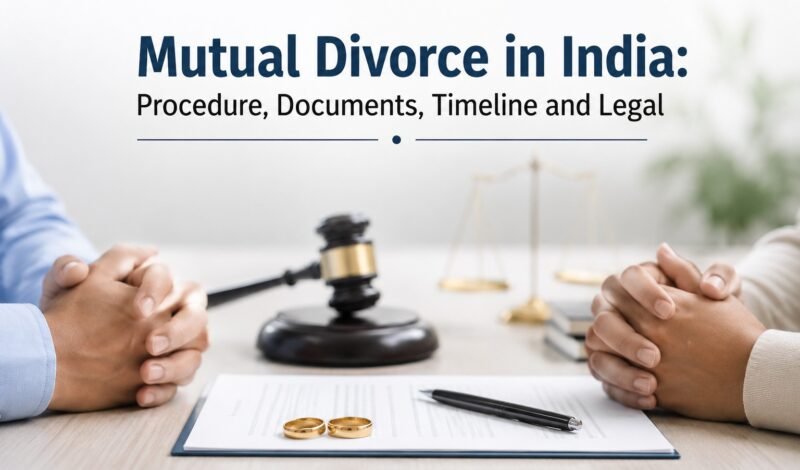

Divorce is a major legal and personal decision, but when both spouses have mutually decided to end their marriage, divorce by mutual consent can provide a more structured and less adversarial legal route. Unlike a contested divorce, where one spouse seeks divorce and the other may oppose it, a mutual consent divorce is based on the agreement of both spouses to dissolve the marriage and settle important issues between them.
For marriages governed by the Hindu Marriage Act, 1955, Section 13B specifically provides for divorce by mutual consent. The law requires the spouses to have been living separately for at least one year, to have been unable to live together, and to have mutually agreed that the marriage should be dissolved. If you are considering a best lawyer for mutual divorce in Delhi, understanding the procedure, documents, timeline and settlement terms beforehand can help you make informed decisions and avoid unnecessary delays.
What Is Mutual Divorce in India?
A mutual divorce is a legal process in which both husband and wife voluntarily agree to end their marriage.
For a Hindu marriage, Section 13B of the Hindu Marriage Act, 1955 provides the legal framework. The spouses can jointly approach the appropriate court when:
- They have been living separately for one year or more.
- They have not been able to live together.
- Both spouses have mutually agreed that the marriage should be dissolved.
Mutual consent does not necessarily mean that both spouses have identical reasons for ending the marriage. The important point is that both must voluntarily agree to seek divorce and continue to maintain that consent through the required stages of the proceedings. The exact legal requirements can differ depending on the law under which the marriage was solemnized. Therefore, a person should consult a divorce lawyer in Delhi to determine which legal provision applies to their individual circumstances.
Mutual Divorce Procedure in India
The mutual divorce process generally involves two important stages known as the first motion and second motion.
1. Discuss and Settle Important Issues
Before filing the petition, both spouses should try to reach clear terms regarding matters such as:
- Permanent alimony or maintenance
- Child custody
- Child visitation rights
- Child education and expenses
- Joint bank accounts
- Jewellery and personal belongings
- Property-related issues
- Outstanding loans or liabilities
- Withdrawal or settlement of pending cases, wherever legally permissible
- Any other financial or personal claims
A properly drafted settlement can reduce the possibility of future disputes.
2. Filing of the First Motion Petition
Both spouses jointly file a petition for divorce by mutual consent before the appropriate court. For a Hindu marriage, Section 13B(1) of the Hindu Marriage Act provides the statutory basis for the petition. The petition generally contains information regarding the marriage, separation, mutual decision to divorce and agreed settlement terms.
The appropriate court depends on factors such as where the parties reside, where they last lived together and other jurisdictional requirements. In Delhi, Family Courts operate across several district court complexes, and Delhi District Courts also provide e-filing facilities for Family Courts.
3. Statements of Both Spouses
The court may record the statements of both parties to confirm that:
- They are voluntarily seeking divorce.
- They understand the settlement.
- There is no coercion, fraud or undue pressure.
- They continue to consent to the divorce.
The court may also examine the settlement and other relevant circumstances.
4. Cooling-Off Period
Under Section 13B(2), the second motion ordinarily cannot be made earlier than six months after filing the first motion and must be made within the statutory period specified in the provision. However, the six-month period is not necessarily an absolute bar in every case.
The Supreme Court in Amardeep Singh v. Harveen Kaur considered whether the six-month period could be relaxed in appropriate circumstances. The Supreme Court has subsequently considered the issue in other cases as well. Therefore, an application for waiver should be assessed based on the facts of the particular case rather than assuming that every mutual divorce can automatically be completed before six months.
5. Second Motion
After the applicable waiting period, both spouses appear before the court for the second motion.
At this stage, the court generally verifies that:
- Both parties continue to consent to the divorce.
- The settlement remains acceptable.
- The requirements of the applicable law have been satisfied.
Mutual consent must remain genuine throughout the process. If one party withdraws consent before the decree is passed, the matter may no longer proceed as a straightforward mutual consent divorce.
6. Final Divorce Decree
Once the court is satisfied that the legal requirements have been fulfilled, it passes the divorce decree. The marriage is legally dissolved from the date specified in the decree.
Documents Required for Mutual Divorce
The exact documents can vary depending on the circumstances and court requirements, but commonly required documents may include:
- Marriage certificate, if available
- Identity proof of both spouses
- Address proof of both spouses
- Passport-size photographs
- Proof of date of birth
- Details of the marriage
- Details regarding the period of separation
- Address and jurisdiction-related documents
- Income or financial documents, where relevant to settlement
- Details of children, if applicable
- Details of jointly owned property or financial assets, where relevant
- Settlement agreement or memorandum of understanding, where prepared
- Details of pending litigation, if any
- Other documents required by the concerned Family Court
It is advisable to prepare the documents carefully before filing because missing or inconsistent information can cause avoidable delays.
How Long Does Mutual Divorce Take in India?
There is no single fixed timeline that applies to every mutual divorce case.
For a Hindu marriage under Section 13B, the statutory framework contemplates a second motion after six months and within eighteen months from the first petition, if the petition has not been withdrawn.
However, the overall duration can depend on:
- Court schedule
- Completeness of documents
- Jurisdiction
- Settlement of financial matters
- Child custody arrangements
- Whether any related cases are pending
- Whether a waiver of the cooling-off period is sought
- Whether both spouses remain available and cooperative
Therefore, it is better to avoid guaranteeing a particular number of days or months without reviewing the facts of the case.
Can the Six-Month Waiting Period Be Waived?
In appropriate circumstances, the cooling-off period may be considered for waiver. The Supreme Court’s decision in Amardeep Singh v. Harveen Kaur established that the six-month period under Section 13B(2) can be relaxed in suitable circumstances rather than being treated as an inflexible requirement in every case. The possibility of waiver should not, however, be presented as an automatic right. The court considers the circumstances and applicable legal principles. If both spouses want to seek an early conclusion, a mutual divorce lawyer in Delhi can assess whether an application for waiver is legally appropriate in the particular matter.
What Happens to Child Custody in Mutual Divorce?
If the couple has children, custody and parenting arrangements should be discussed before finalising the settlement.
The agreement may address:
- Physical custody
- Visitation rights
- School and education expenses
- Medical expenses
- Travel arrangements
- Communication with the child
- Financial support
- Future changes in parenting arrangements
The welfare and best interests of the child remain important considerations. Parents should therefore focus on creating a practical arrangement that protects the child’s interests rather than treating custody simply as another settlement term.
What About Alimony and Maintenance?
Alimony or maintenance can be an important part of a mutual divorce settlement.
The spouses may discuss whether:
- One spouse will pay a lump-sum amount.
- Periodic maintenance will be paid.
- There will be no claim for maintenance, where legally appropriate.
- Existing financial claims will be settled.
- Certain assets or liabilities will be divided between the parties.
Because financial circumstances vary considerably, there is no universal formula for determining the amount of settlement. A family lawyer in Delhi can help review income, assets, liabilities and other relevant circumstances before the settlement is finalised.
Why Hire a Mutual Divorce Lawyer in Delhi?
Although mutual divorce is generally less adversarial than a contested divorce, it still involves important legal and financial decisions.
An experienced divorce advocate in Delhi can assist with:
- Understanding the applicable law
- Checking court jurisdiction
- Preparing the mutual consent petition
- Drafting settlement terms
- Reviewing maintenance and alimony arrangements
- Addressing child custody provisions
- Preparing required documents
- Representing the parties before the Family Court
- Advising on the second motion
- Assessing whether a cooling-off period waiver may be appropriate
Delhi has multiple Family Courts and mediation centres, including centres associated with Tis Hazari, Karkardooma, Rohini, Dwarka, Saket and Patiala House Courts. Delhi District Courts also recognise mediation as a mechanism through which matrimonial disputes can be addressed, and lawyers may assist parties during mediation.
Mutual Divorce vs Contested Divorce
| Mutual Divorce | Contested Divorce |
| Both spouses agree to divorce | One spouse may oppose the divorce |
| Settlement is generally negotiated | Issues may be disputed before the court |
| Usually less adversarial | Can involve prolonged litigation |
| Financial and custody matters can be settled mutually | Court may need to adjudicate disputed issues |
| Both parties participate in the process | Parties may take opposing legal positions |
| Generally more predictable when cooperation continues | Timeline can be considerably less predictable |
The most suitable approach depends on the facts of the marriage and the willingness of both spouses to resolve their issues.
Important Things to Settle Before Filing Mutual Divorce
Before filing a mutual divorce petition, couples should carefully discuss:
- Financial settlement: Clearly record the agreed amount and payment schedule, if any.
- Child custody: Decide custody, visitation and financial responsibilities.
- Property: Address jointly owned property and other significant assets.
- Personal belongings: Clarify return or division of jewellery, documents and belongings.
- Pending cases: Obtain appropriate legal advice regarding the treatment of existing proceedings.
- Future claims: Ensure the settlement accurately records what has been agreed upon and what remains outstanding.
A vague settlement can create problems later, so professional legal drafting is important.
Choosing the Right Divorce Lawyer in Delhi
Choosing the right legal professional can make the process easier to understand and manage.
When searching for a divorce lawyer in Delhi, consider:
- Experience in matrimonial and family law
- Understanding of mutual consent divorce proceedings
- Experience before Family Courts
- Clear communication about the process
- Transparent discussion of legal fees
- Careful review of settlement terms
- Practical advice rather than unrealistic promises
Avoid choosing a lawyer solely because they promise a guaranteed divorce within a specific number of days. The actual timeline depends on the court, facts of the case and applicable law.
Conclusion
Mutual divorce can provide a structured legal option for spouses who have jointly decided that their marriage should come to an end. However, the process involves much more than simply signing a divorce agreement. From determining jurisdiction and preparing the petition to settling alimony, child custody, property, personal belongings and other claims, each part should be handled carefully.
For marriages governed by the Hindu Marriage Act, Section 13B sets out the framework for divorce by mutual consent, including the requirement of separation and the two-motion process. If you are considering mutual divorce in Delhi, taking advice from an experienced divorce lawyer or family lawyer in Delhi before signing a settlement can help you understand your legal position and avoid unnecessary complications.
Frequently Asked Questions (FAQs)
- What is mutual divorce in India?
Mutual divorce is a legal process where both spouses voluntarily agree to dissolve their marriage. For Hindu marriages, Section 13B of the Hindu Marriage Act, 1955 provides for divorce by mutual consent.
- How long does mutual divorce take in India?
The timeline depends on the circumstances and court proceedings. Under Section 13B, the second motion is ordinarily made after six months from the first petition, subject to the applicable legal provisions and any legally permissible waiver.
- Can the six-month cooling-off period be waived?
In appropriate circumstances, the cooling-off period may be waived. The Supreme Court has recognised that the period can be relaxed in suitable cases. However, waiver is not automatic and depends on the circumstances and applicable law.
- What documents are required for mutual divorce?
Common documents include identity and address proofs, marriage-related documents, photographs, information about children and financial or settlement-related documents where applicable. The exact requirements can vary by case and court.
- Do both spouses have to agree to mutual divorce?
Yes. Mutual consent is fundamental to this form of divorce. Both spouses must voluntarily agree to the divorce and maintain the required consent through the relevant stages of the proceedings.
- How can I find a mutual divorce lawyer in Delhi?
Look for a lawyer with experience in matrimonial and Family Court matters who can clearly explain the procedure, settlement issues, documents, costs and likely timeline. A mutual divorce advocate in Delhi should also review your individual circumstances before advising you on the appropriate legal route.